Saturday, March 15, 2014

U.S. Diplomats & Bicycles

The Library of Congress just moved a set of materials that are the transcripts of oral histories of U.S. diplomats. The collection is describes as follows:
Frontline Diplomacy: The Foreign Affairs Oral History Collection of the Association for Diplomatic Studies and Training at the Library of Congress makes available interview transcripts from the oral history archives of the Association for Diplomatic Studies and Training (ADST). These transcripts present a window into the lives of U.S. diplomats and the major diplomatic crisis and issues that the United States faced during the second half of the 20th century and the early part of the 21st.
Full text search of these items is part of using the simple "one box" search for the entire website. This leads to what seems to me to be an amusing result - a suggestion the there is a significant linkage between diplomacy and bicycling. If you search "bicycle" across the entire LOC.gov site, the search results indicate that of the "sites and collections" within LOC.gov, Frontline Diplomacy is in sixth place as a "site or collection" for this search term. What this actually indicates is that if you ask 1,700+ people to talk about their life story, it isn't uncommon that they will mention "bicycle in passing, often for these 20th century diplomats in the context of "I rode a bicycle to school" type statements. (The most that "bicycle" appeared in any interview was three times - much more typical was one mention.)

Even my father, someone who I don't recall ever seeing ride a bike, mentioned "bicycle" twice in his interview! His interview is not about policy so much as anecdotes of life in the foreign service. One "bicycle" event was in Tunis:
For example, in the early summer of 1951, I bought a lovely 20 x 14 foot Kairouan carpet — all white. That fall, the U.S. Sixth Fleet paid a visit to Tunis — that is to say that Admiral Gardener and his carrier, the Coral Sea, anchored some miles off shore (Tunis is a shallow road stand). Anyway, at one point the Admiral and many of his colleagues ended up at my house — until about four A.M. — when the last was fished out of the pool and sent on his way. As you can imagine, many an hors d'oeuvre was ground into my Kairouan carpet. When I finally staggered out of bed the next morning, Ali, my cook, said that someone had stolen the carpet. He had not wished to disturb me, but he had washed the carpet and hung it out to dry, and someone had rolled it up and fled with it on a bicycle. So — that was the last I ever saw of the Kairouan carpet.
Another mention was of his work in Moscow in the 1950s as a General Services Officer:
As General Services Officer (or housekeeper), I had some sixty Russians working for me, only one of whom spoke any English. The rest were carpenters, mechanics, painters, plumbers, laborers, what have you. Two things happened immediately — I changed the sign on my door to read “Genial Services” and, secondly, I set out to work with my “team.” I won't say we were totally successful. We tried to keep people (including Mrs. Bohlen) happy by doing what we could. And, I think, by and large, we succeeded. There were, of course, some people who could not be kept happy. Like the Air Force Attache (departing) who called up in a rage one day because we had dismantled his daughter's bicycle to be shipped home. Did we realize it would cost him money to have it reassembled in the U.S.? We put it back together for him — forget the U.S. taxpayer.
So while there are some mentions of bicycles in these materials, arguably diplomatic history is not, as perhaps suggested by the search system, a rich source of information generally about bicycles.

I am reminded that while I don't recall my father riding a bicycle, I do remember his putting a bicycle together. While living in Bucharest in the 1960s, the U.S. Embassy community included (all things considered) a relatively large number of children roughly my age - I don't know how this was done, but a number of Raleigh Grand Prix bicycles were purchased and imported by the parents of many of these children one Christmas season. My father, being pragmatic in such things, had assembled the bicycle well in advance (he was also pretty good as a mechanic). But the night before Christmas I overheard him talking to someone in our house (my bedroom was at the top of the stairs above the diplomatic-reception-sized living room) and clearly assembling a bike. I learned years later that he was helping some American military attache by assembling the same sort of bike for the attache's child, the attache not having properly understood "some assembly required." This is somewhat ironic, I suppose.

As a tangential connection with cycling history, I have blogged before about the most famous U.S. diplomat-cyclist, Alvey Adee.
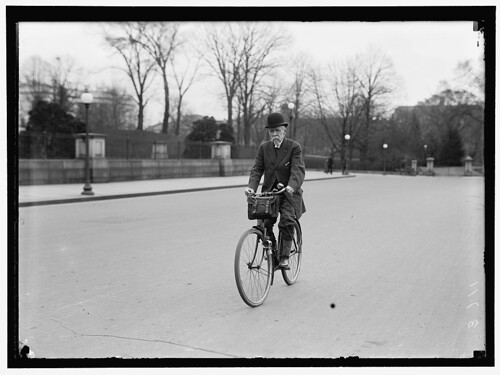
Alvey Adee of Dept of State Riding Bicycle to Work(1914)
Alvey Adee of the U.S. Department of State riding his bicycle to work in 1914

Saturday, March 8, 2014

Cycle Chic by Mikael Colville-Andersen (Book Review)

Cycle ChicCycle Chic by Mikael Colville-Andersen

My rating: 5 of 5 stars


First - my five stars is because as I understand Goodreads, the idea for assigning stars is did I like the book and not is it a good book generally.

This a book of photographs with very little text, loosely organized thematically, from Mikael Colville-Andersen, the Copenhagen-based creator of the blog Copenhagen Cycle Chic.

The photographs are about the people in them and the bicycles they are with together, in support of the "Cycle Chic Manifesto". This manifesto declares things like, "I choose to cycle chic and, at every opportunity, I will choose Style over Speed" or "I will endeavour to ensure that the total value of my clothes always exceeds that of my bicycle" and "I will refrain from wearing and owning any form of 'cycle wear'."

The book includes hundreds of color photographs (and a very small number of B&W) taken all over the world, but predominately in Europe, in particular in Copenhagen. Most but not all were taken by Colville-Andersen and most appear unposed.

The role that such a (physical) book plays in our world today is an interesting (perhaps) question - one can see many of the kinds of photographs included in the book in the Copenhagen Cycle Chic blog (or many of the similar blogs that Cycle Chic provides links to). One can also see
Colville-Andersen's photos
in his Flickr account (although there are plenty of non-bicycle photos there, too). I don't have an answer to this question - in this particular case, the book seems pleasing because it emphasizes the photographs one-by-one in a way that neither Flickr nor the blog presentations do, and allows for flipping around that the Internet still doesn't support.

Fun. Good.


View all my reviews of cycling books on Goodreads.

Sunday, March 2, 2014

Book about Schwinn HIstory in the Pubic Domain

Schwinn Roadster
Page from this company-sponsored history of Schwinn from 1945

Fifty years of Schwinn-built bicycles: the story of the bicycle and its contribution to our way of life. Arnold, Schwinn and company, Chicago. 1945. No author is given on the title page, but the dedication is from Frank Schwinn, son of the company founder, Ignaz Schwinn.

Typically books published after 1922 in the U.S. are still covered by copyright, but if published before 1964 (I think) then copyright has to be renewed after 28 years or the book goes into the public domain. Or perhaps the University of Michigan where this was digitized cleared the copyright otherwise somehow. Anyway, the full book is viewable through HathiTrust.

While primarily a book about Schwinn, looking back from 1945, there is quite a bit of general cycling history in this too (albeit presented in summary). There are some interesting photographs comparing a Schwinn factory in 1895 and 1945, and some discussion of the development of bicycle technology as it relates to technology in (then) automobiles and even airplanes. In many ways it is more interesting for someone interesting in Schwinn and bicycles than the much more recent No Hands that was published in 1996 but is more about Schwinn as some kind of extended business case study. (350 pages, published by Henry Holt & Co.)

Schwinn Family On Bike
The Schwinn family on a bicycle built for three

Schwinn's introduction of the balloon tire in 1933 is described in detail and makes clear that the bicycle industry in the U.S. following the initial craze of the 1890s had been negatively affected by the "single tube" tire that was difficult for individuals to repair but cheap for bicycle makers to sell.
THE BALLOON BICYCLE TIRE
The antiquated single-tube tire had been standard equipment on American bicycles from the 90's to 1933. Small double-tube tires were available, but expensive and little used. Everywhere else in the world only double-tube tires had been used for a generation, because they were readily repairable, while the single-tube tire was not. Small punctures in the single-tube tire could be repaired by makeshift methods, but large punctures could not be repaired satisfactorily, and a cut of any size meant the purchase of a new tire. The fiction that the American cycle buyer just wouldn't pay the additional cost of the practical, repairable, double-tube tire had taken root, and no serious attempt was made to encourage their use.

Schwinn Balloon Tire Ad 1933
Ad for Schwinn's 1933 bike featuring a balloon tire in the U.S.

Saturday, March 1, 2014

Snow & Fenders


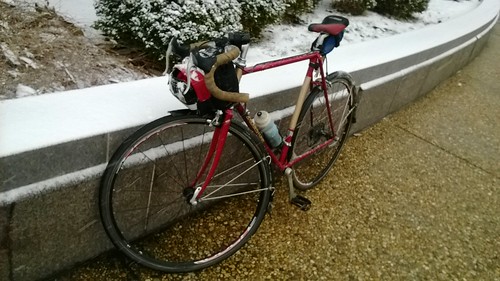
Having arrived at work after riding mostly in about 1/2-1 inch of snow

On Tuesday it was starting to snow when I got up in the morning and starting to accumulate a little on the trails when I was ready to take off for work. Still, the promised weather for later was that the snow would stop, the sun would come out, and there would be enough warmth for all this to go away.

In previous experience, I have found that riding a road bike in fresh snow where there is no ice underneath can be easier than riding a mountain bike with big wide tires - and it seemed I wouldn't need any sort of special snow or ice compensation for the ride home. So I chose to ride my 1982 steel road bike (or whatever one calls such a thing) to work. I lower the tire pressure a bit to improve grip.

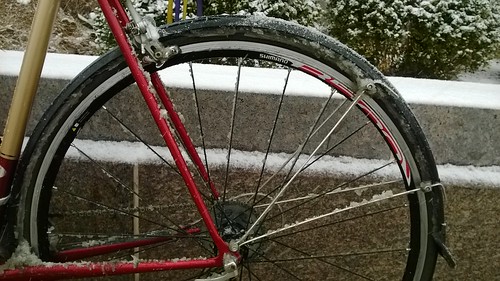
On the trails the snow was less than an inch, generally (that is, less than 2.5 centimeters). After a while I started hearing a high pitched noise from a tire in contact with something and realized that the way the rear fender is fitted, snow was building up at the back and pressing against the tire, making the noise. It didn't seem to be causing me to work noticeably harder, however.

When I crossed the 14th Street bridge into Washington, however, the snow was deeper on the bridge section set aside for pedestrians and cyclists and somehow the difference meant snow was building up under the fender enough to slow me down. The bridge is long enough that it was beginning to wear, but for whatever reason it got to a certain point and didn't get so bad that I was stopped.


Snow built up under rear fender in particular

The above photos are after I got to work (but before I entered the parking garage, which since it is heated, quickly melted all this messiness). In DC there was much less snow and almost none on the roads I was riding on, but you can still see the build up problem.

So I learned something - road bikes may be fine for certain snowy conditions, but not with fenders, or at least not with fenders fitted this closely.

Saturday, February 22, 2014

Capital Bikeshare Usage Visualized

Mobility Lab, a kind of think tank/advocacy organization in Arlington (Virginia), has this blog post that links to interactive displays of various kinds of usage of the Capital Bikeshare system based on 2013 statistics displayed on an aerial photograph of DC and northern Virginia. One of the amazing things about bikeshare systems is that they provide detailed statistics about cycling that have never been available before.

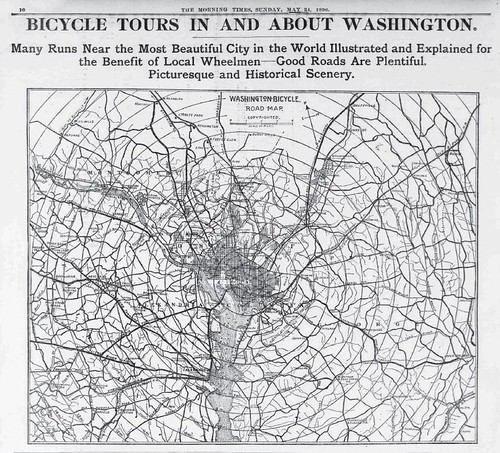
Washington DC Bicycle Map, 1896
PDF of map for cyclists in the Washington DC Morning Times, May 24, 1896

The above "Washington Bicycle Road Map (presented in a newspaper) is one I like very much since it covers so much of the DC region - it reminds me that at that time, the growing popularity of cycling was about leisure riding and a significant part of that for long rides into the countryside (which would now be suburbs, mostly). The city was only around a quarter of a million people after all. The map extends at least 12 miles out in all directions from the center of DC.

Monday, February 17, 2014

"Bicyclists, Get Off the Road"

A letter to the editor of the Yakima Herald-Republic (in Washington state) is titled, "Bicyclists, get off the road" and starts out:
Yes, it keeps happening. People riding their bicycles on roads and highways designed for motorized traffic. Thank God my parents had enough common sense to beat my rear end and ground me if they caught me riding my bike in the street. Just because the law allows stupidity does not mean you have to make yourself a dangerous liability. . .
- and so on, from some fellow in Moxee (apparently a place in eastern Washington state).

What a point of view, from one a resident of one of the top bicycling-friendly states in the nation! I guess this says something about the divide between urban sensibilities and whatever Moxee Washington represents.

On the other hand, we have this.

The Power of Bicycling (Get Psyched) from Streetfilms on Vimeo.

Yeah.

One wonders if the Man from Moxee is aware that the Good Roads Movement" that created all these roads he feels belong to motorists exclusively was started by cyclists (then known as "wheelmen"). OK, OK - one could add that they were helped in organizing by bicycle manufacturers like Colonel Pope. One can read about these efforts in their monthly journal from the 1890s, entitled "Good roads: an illustrated monthly magazine devoted to the improvement of the public roads and streets." There were no motor vehicles.

Sunday, February 16, 2014

Looking Forward from 1894 - Cycling Options

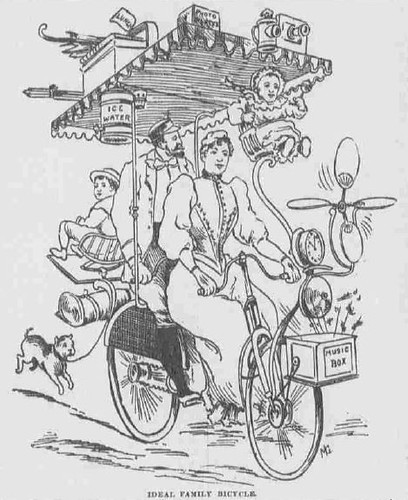
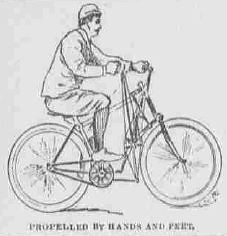
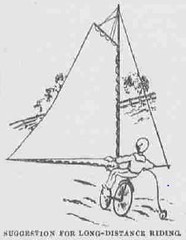
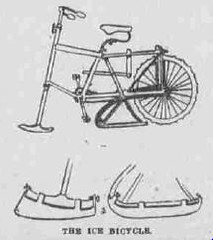
I found a curious and amusing article in the Phillipsburg Herald (Phillipsburg, Kansas) from April 5, 1894. In the 1894 the "bicycling craze" of the 1890s was well underway but the "safety bicycle" (that is, a bicycle with the basic design we still have today) was still being improved each year and the peak of the craze would not be until 1896-1897. As with any "craze" there was speculation as to what might come next - this long article from the middle of the United States covered the possibilities (most of which were quite improbable) extensively, with illustrations.

Ngram results - wheelmen
nGram shows discussion of "wheelmen" in newspapers peaked 1896-1896 -- 1894 was still early

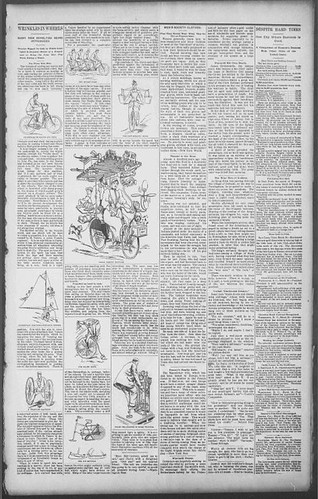
As you can see below, the article on bicycles and cycling took up the entire left side of the full page.

Entire Page
Image of the full newspaper page

The article begins:
The friends of cycling are legion and their number is augmented every day. As a sport it remains as popular as ever, and during the enforced dullness of tho winter months the cyclist dreams but of the perspective enjoyment another season. Long before the advent of the first robin and the timid crocus, the wheelman has burst in full bloom and can be seen gayly "pumping" through mud and slush having a glorious time in making himself and others believe that gentle spring has come.
Then it continues with illustrations and descriptions of a variety of possible bicycle types, including some more imagined than real.

Bicycle Ideal for a Family
A fanciful illustration suggests the skepticism of many about cycling at the time

Hand & Feet Driven Bike
A bicycle driven by one's arms as well as legs

Sail Bicycle
A bicycle equipped with a sail

Ice Bike
A bicycle equipped for ice (only)

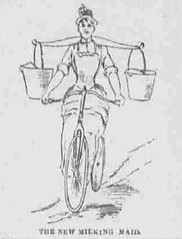
Milking Maid Bicycle (?!)
An apparently regular bicycle used to help create a "new" milking maid

DSC_0083
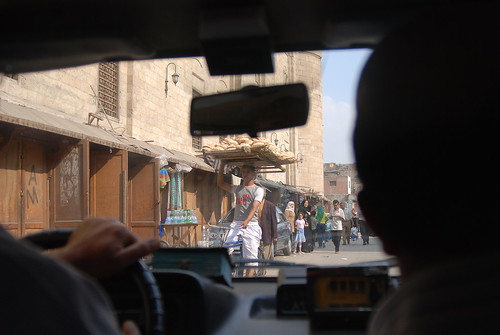
Cargo carrying with bicycles can require considerable skill - Egypt, 2008 example

Yes, this fellow is riding along with an open tray of Egyptian flatbread on his head.