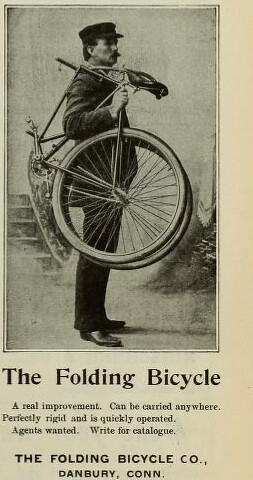
A folding bike for the 19th century
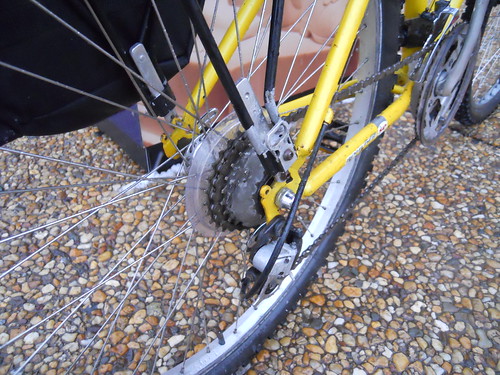
There are not all that many truly new ideas in basic bicycle design.
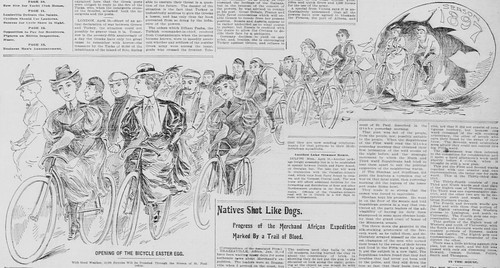
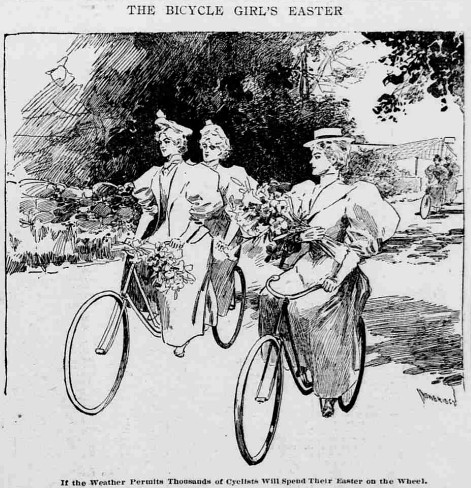
Cycling is popular among children, but results in thousands of injuries annually. In recent years, many states and localities have enacted bicycle helmet laws. We examine direct and indirect effects of these laws on injuries. Using hospital-level panel data and triple difference models, we find helmet laws are associated with reductions in bicycle-related head injuries among children. However, laws also are associated with decreases in non-head cycling injuries, as well as increases in head injuries from other wheeled sports. Thus, the observed reduction in bicycle-related head injuries may be due to reductions in bicycle riding induced by the laws.The report is interesting and some of what it says is of more general interest than just helmet usage by children. They aren't impressed with the rigor of previously done studies looking at helmet use by children (there are only two) and they take care to compensate for those errors. Their results suggest that the main reason why helmet laws reduce head injuries is more about reducing the amount of bicycling than by better outcomes from accidents thanks to wearing helmets. The last paragraph of the report concludes:
The findings from this paper indicate that while bicycle helmet laws are widespread and thought to be effective, the net effect of these laws on health outcomes is actually not straightforward. It is clear that there are offsetting behaviors and unintended consequences of these laws, and these effects need to be considered by policymakers.

RUSSIA'S FUTURE CHAMPION - Peter Akmatow-Dombrowski and His Many Brilliant Performances.
Peter Akmatow-Dombrowski, the subject of this sketch, will, it is safe to predict, play a leading role on Russian race tracks the coming season; in fact, there is little doubt that he is the best man on the track in Russia to day. He is a native of Kiew and twenty-one years of age. Although active at racing since his fifteenth year, he was not prominent until 1895, when at Moscow he came within a fraction of an inch of winning the Russian mile championship from Djakow.
This being the first time he had met the faster men of his country, his performance caused intense surprise. All previous minor events in which he started were won by him, this being his first defeat. He holds the Eussian unpaced records for the quarter, eighth, and half verst, and the quarter English mile.
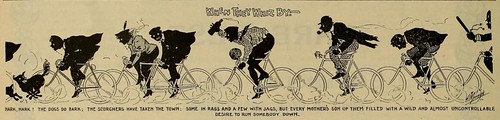
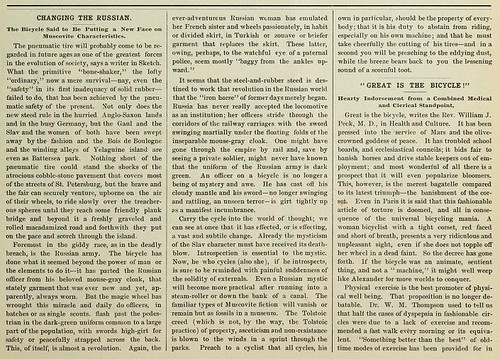
CHANGING THE RUSSIAN - The Bicycle Said to Be Putting a New Face on Muscovite Characteristics.and this extended reference to Tolstoy~
. . . Not only does the new steed rule in the hurried Anglo-Saxon lands and in the busy Germany, but the Gaul and the Slav and the women of both have been swept away by the fashion and the Bois de Boulogne and the winding alleys of Yelaguine island are even as Battersea park. . .
Carry the cycle into the world of thought; we can see at once that it has effected, or is effecting, a vast and subtile change. Already the mysticism of the Slav character must have received its deathblow. Introspection is essential to the mystic. Now, he who cycles (also she), if he introspects, is sure to be reminded with painful suddenness of the solidity of externals. Even a Russian mystic will become more practical after running into a steam-roller or down the bank of a canal. The familiar types of Muscovite fiction will vanish or remain but as fossils in a museum. The Tolstoic creed (which is not, by the way, the Tolstoic practice) of property, asceticism and non-resistance is blown to the winds in a sprint through the parks. Preach to a cyclist that all cycles, his own in particular, should be the property of everybody; that it is his duty to abstain from riding, especially on his own machine; and that he must take cheerfully the cutting of his tires—and in a second you will be preaching to the eddying dust, while the breeze bears back to you the lessening sound of a scornful toot.


