Saturday, April 12, 2014

The Bike Deconstructed (Book Review)

The Bike Deconstructed: A Grand Tour of the Modern BicycleThe Bike Deconstructed: A Grand Tour of the Modern Bicycle by Richard Hallett

My rating: 5 of 5 stars


This is one of those rare books that I get from the public library that I will probably buy a copy of later. Overall it is well done and interesting for someone with a general interest in cycling and bicycle history but who is not an expert already.

As with many books, the "blurb" is disingenuous - it says, "Do you know the difference between a head tube and a headset?" [and several other such questions] If not, this is the perfect guide for you. This sort of over-inclusive enthusiasm from the publisher (one assumes) is amusing, but probably not accurate. At less than 200 pages and with half of most pages allocated to photographs and the occasional diagram, the author assumes a fair degree of interest and acquaintance with bicycles and is a few steps beyond an introduction that clarifies what's what.

The focus is on "road bikes" but as the author explains, more than just for road racing - "the road bike is a fast- and easy-running machine with ergonomics suitable for a wide range of riding conditions. More specifically, it is a lightweight bike equipped with dropped handlebars, narrow(ish) tires, and an efficient connection between feet and pedals."

There are seven chapters: Materials, Frameset, Wheels, Drivetrain, Brakes, Contact Points, and Accessories, along with a glossary, index and limited suggestions for other reading.

Because of the abbreviated length of the text, the author makes quite a few categorical statements about subjects where there are other opinions - that's just a consequence of this kind of approach. In 35 pages he says what he can about road bike drive trains but there is no comparison to the detail in something like The Dancing Chain at 400 pages.

This isn't a book that I have sat down and read from cover to cover - although I suppose you could. I page around, look at the photographs, read the captions, maybe read some of the text, learning a few things and being entertained. A caption for a photograph of a modern handlebar says, "The oversized bulge at the handlebar center point adds strength and stiffness where needed as well as increasing the surface area available for clamping." Oh - I wondered about that. An explanation of the benefits of the modern threadless headset over the more traditional threaded headset convinced me of the advantage of the modern approach (even as I continue to admire the elegance of the appearance of my 1982 road bike with a threaded headset).

The photograph credits are from dozens of sources, mostly manufacturers, which is surprising since they were processed to achieve a standard and pleasing appearance in the book.

A fun and entertaining book to have around.


View all my reviews of cycling books on Goodreads

Saturday, April 5, 2014

Denmark and Cycling in 1898

Evening star. (Washington, D.C.), 16 April 1898. has this short item on its page featuring a variety of stories about cycling for the many in those days who were interested in the topic, towards the end of the cycling craze of the 1890s. This was arguably more for business types interested in selling bicycles in Denmark but has some interesting description, from an American perspective, of cycling in Denmark at the time.

FOREIGN BICYCLE TRADE
Recent reports received at the State Department give some interesting facts in regard to the bicycle in European countries.
Vice Consul Bloom in Copenhagen says: "All classes, from the royal princes and princesses to the poorest workmen, use the bicycle in Denmark. The number now in use is estimated at about 100,000 for a population of 2,300,000). The roads through out the kingdom are excellent. Denmark is a flat country, with hardly any hills, and must be considered ideal from a cycler's point of view. If American exporters ship frames and wheels separately, they are sure to be on the safe side, or they can stipulate that they will not have anything to do with the duty, and leave that question to be settled by the Danish importers. There are no differential duties. The retail prices are from $25 to 100. The demand is mostly for the cheaper grades, and large quantities have been sold recently at $10 free on board New York."

From the National Museum of Denmark - in 1940 King Christian X could have chosen a bike, but certainly everyone else here seems to have done so

This situation is contrasted with that of Germany, also describe:
Consul General Cole at Dresden says: "Bicycles are used in Dresden by the wealthy and the middle or well-to-do classes. The lower and poorer class could hardly hope to accumulate enough money to buy them, although the remarkable reduction In the prices of American wheels may place them within reach. The streets of Dresden lire paved with asphalt and stone blocks, or macadamized, and are kept hard and smooth by constant rolling. They are clean, and furnish delightful avenues for wheeling. In the Grosser Garten are many miles of dirt roads, level and smooth, and, besides these, roads are being made in the park exclusively for cycling. Throughout Saxony the roads are hard smooth, and kept in good repair. Americans supply the largest number of wheels sold In this market, but there is considerable traffic in English bicycles."
The article goes on to describe the situation in similar detail for selected regions of Italy, France, Spain, and (somewhat oddly - since it is not part of Europe) Canada. (The article starts on the bottom of the page, fourth column from the left.)

Sunday, March 30, 2014

World War I: German Bicycle Corps


Rotogravure of German Bicycle Corps soldiers WWI

An image from "The War of the Nations" published in 1919, made up of rotogravures taken during World War I from the New York Times. Rotogravures were photographs printed in newspapers using a higher quality process than was typical, producing better results - this comes from a volume published in 1919 after the war was over, a compilation of photographs taken by news photographers.

The photographs in books like this, with minimal (and fairly self-evident) captions, often raise all sorts of questions. Here the soldiers with bicycles are "marching with difficulty over the sand dunes" - one has to wonder, why are they bothering to do this? And why are they heading in one direction while behind them we see a column of soldiers (the same army) heading in the opposite direction? It is noticeable without much examination that the soldiers heading left-to-right seem to all have backpacks, while those heading right-to-left are (mostly) not doing so. And so on. One will likely never know. Not, of course, that it matters.

Saturday, March 29, 2014

World War I - Americans Race Bicycles in France

The Stars and Stripes (Paris, France), February 7, 1919, Vol. 2 No. 01, page 6 has the following short story about a bicycle race held by the American Expeditionary Force during World War I.
BICYLE RACE IS LATEST WRINKLE

5th Army Corps to Hold Thirty Kilometer Pedal Speed Contest

On Saturday, February 15, the Fifth Army Corps will stage a bicycle road race from Bourbon les Baines to Nogent en Bassigny, a distance of about 30 kilometers. Three teams of 20 men each will start, representing the 29th and 82nd Divisions and the Fifth Army Corps troops.

There will be a trophy for the team having the greatest number of men to finish, as well as individual prizes. Bicycle road race rules will govern. There will be no pacing other than that done among the contestants themselves, and controls will be established where assistance may be given the contestants.

Colonel Foster, athletic officer of the Fifth Corps., is in charge of the details of the competition, which he claims will forever put a stop to the arguments about the speed of the couriers in the recent big offensive.

All along the course organizations are arranging to give the riders a big reception. The finish will be at the foot of a big hill in Nogent en Bassigny, near Major General Summerall's chateau.


Article as it appeared in the Stars & Stripes

This kind of activity, a recreational race, was possible since the war had ended in November 1918.


Image of scout (not messenger) cyclists in World War I

Sunday, March 23, 2014

Arlington County (VA) and Trail Plowing

March 9 I sent the following as an email to the Arlington Bike Coordinator; later I submitted a revised version to the County Board on their website.

It appears that over the winter the County decided to switch from salting trails to plowing. (I leave near Rt 7 and Walter Reed and ride down the trail along Walter Reed, then down the trail along Four Mile Run to the Mt Vernon trail and then in to DC that way.)

I am surprised by the timeliness of some of the plowing that happened - in particular, the that runs parallel to Walter Reed between Rt 7 and Arlington Mill Drive was plowed recently very quickly after the snow - this makes a lot of sense since if you are going to plow trails (and not salt), it should happen fast before the snow turns into ice from people walking on it.

The different this past week was very noticeable between the trails I use in Arlington and the Mt Vernon Trail, which was untreated and unplowed. The main thing was that the trails that were plowed become clear and useable by a regular bike quickly and the Mt Vernon trail was only rideable until Thursday either by riding very carefully or by having a bike with studded tires (which I have).

Plowing isn't a perfect solution - Tuesday in particular some trails had been plowed before my morning ride but the result was that the asphalt (with the 15 degree weather) was coated with a thin sheet of ice instead of a thicker layer of ice and snow so that a regular bike would not have traction - it would have been impossible to ride without studded tires. But by that afternoon the situation was already better, and Wednesday morning the Arlington trails were rideable (with care) while the Mt Vernon trail was not. Still, I think plowing is better than treating with salt etc.

The plowing is good. Thank you.
Untitled
Plowed trail near my house - makes a big difference!

This kind of systematic effort to clear trails used by cyclists (and others, of course) following snow storms is new this year in Arlington, and there was enough snowy weather for some experimentation. The first round was to use salt/road treatment type applications on the trails, which isn't great if you want to walk a dog using the trail and also is hard on the bicycle and the surrounding environment since the salt/chemicals aren't confined to the trail (asphalt). Plowing is a lot better, and the County shifted to that, which is great.

Better still would be to have a little less snow.

Tuesday, March 18, 2014

Walking the 14th St Bridge (on the Way to Work)

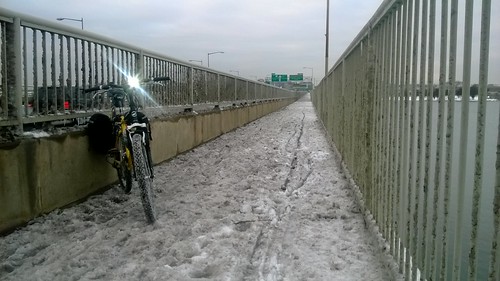
14th St Bridge, March 19 2014
Doesn't look too bad . . .

I used my "ice & snow" bike and was reminded it is better with ice and less good with some snow conditions. Most of the ride the asphalt trails were much more clear than I expected and with my studded tires I chugged along steadily. But the 14th St Bridge pedestrian/bicycle area was 3-4 inches of mush (not slush, but mush) that was hard to maintain forward motion with given the 2 inch wide tires and a desire not to spin the wheels (which could pull out studs, maybe) and the sort of wild steering required.

Anyway I ended up walking more than half the way since it was a more consistent level of effort and probably about the same speed as the stop-and-go approach with riding in my lowest gear.

Sunday, March 16, 2014

The Elite Bicycle: A Portrait of the World's Greatest Bicycles (Book Review)

The Elite Bicycle: A Portrait of the World's Greatest BicyclesThe Elite Bicycle: A Portrait of the World's Greatest Bicycles by Gerard Brown

My rating: 3 of 5 stars


This is a coffee table book with lots of color photographs of bicycles and a fair amount of accompanying text to provide context, but I overall I was disappointed. (However since I checked this out of my public library, not terribly. I certainly wouldn't want to have spent money on this one.)

Published in the U.S. by VeloPress, this was originally published in the U.K. by another publisher. While there is some discussion of U.S. bike companies, the original audience was more European than American (or so it seems to me). And the change in the sub-title for the American edition somewhat confuses what the book is about, I think - originally it was "The Elite Bicycle: Portraits of great marques, makers and designers" and in the U.S. it is "The Elite Bicycle: A Portrait of the World's Greatest Bicycles." (Isn't the American version a tautology?)

I'm not sure the original British title is entirely consistent with the content of the book, but it is certainly more suggestive of the information in it the American one. As another person wrote, this isn't a book about bicycles so much as about bicycle parts, and there is something to that - but of course, a modern "elite bicycle" is in fact a collection of parts since there is no one company that creates both the frame+fork and then the group of parts that are bolted to that frame+fork. Also not clear from the (American) title and somewhat unexpected is the heavy emphasis on the manufacturing process rather than finished products.

I found it a little puzzling that the book doesn't present a particular kind of bicycle as this desirable "elite bicycle" clearly. This was not, as I was expecting from a book from VeloPress (not realizing that this was not their creation), oriented towards pure road racing bicycles but rather high end road bicycles for individuals who like really nice bikes but aren't going to be using them as professional cyclists. Most of the companies (those covered I have listed below) are frame builders that specialize in bespoke bicycles (i.e., built to the customer's specific requirements) but not all. And some high end bicycle parts-making companies are covered, such as Chris King and Sapim. A French family business that produces what are the world's best tubular racing tires is covered presumably because they are "the greatest" but very few of the bikes otherwise discussed would use such tires - and then, out of some sense of fairness perhaps, there is a description of Continental's tubular tire manufacturing process, too (which is in Europe, unlike most European company bicycle tires that are now made in Thailand or Taiwan, such as Michelin).

Probably the greatest shortcoming of the American title is that it suggests that the authors consider these particular bikes (and parts) to be the world's greatest. The British title is more clear that this is just about some examples of elite bicycles and not "the list." The book is very clearly (upon reading) intended as a sampling of the various ways such elite bikes are produced and not a collection of the very best.

The foreward by Sir Paul Smith sets a new standard in brevity. But they did get to put his name on cover. So there.

The Library of Congress catalog record for this book includes a list of the companies covered: Brooks -- Selle Italia -- Reynolds -- Columbus -- Cinelli -- Guru -- Chas Roberts -- Rourke -- Cyfac -- Alex Singer -- Fagg in -- Pegoretti -- Independent fabrication -- Richard Sachs -- Ben Serotta -- Condor/Paris -- Seven -- Dinucci -- Ira Ryan -- Tony Pereira -- Winter -- Spécialités TA -- Sapim -- Chris King -- Royce -- Mavic -- FMB -- Continental -- Time -- Contacts.


View all my reviews of cycling books.